



Seasonal Campaign Planning: Getting Ahead of the Calendar

Performance Digital • November 16, 2026

Your customers don't think the same way in February as they do in November. Their budgets shift, their priorities shift, and so does what catches their eye in a scroll. Yet many businesses launch one set of ads in January and let it run, untouched, until the numbers start to slide.


That "set it and forget it" approach quietly drains your budget. The brands that get the strongest return on ad spend treat the calendar as a strategy tool. They plan each season before it arrives, refresh creative on a schedule, and shift spend toward the moments when their customers are most ready to act.


This post walks through why seasonal planning matters, what to change each quarter, and how far ahead you should be working. Along the way, we'll share examples from campaigns we've run for businesses in hospitality, retail, healthcare, financial services and live events.

Why the calendar changes your ROI

Seasonality affects three things at once: what you pay, who's ready to buy, and how long your creative stays effective. Ignore any one of them and your cost per result creeps up.


1. Ad costs rise and fall with demand

Paid platforms run on auctions. When more advertisers compete for the same audience, prices go up. The fourth quarter is the clearest example: from Black Friday through the holidays, retailers flood every platform and costs climb. If you sell something that isn't tied to holiday gifting, that's often the worst time to push hard. The quieter weeks right after New Year can deliver the same audience for less.


Knowing your industry's peaks lets you spend more when it pays off and pull back when you'd only be outbidding giant retailers.


2. Customer intent follows the season

People search and buy in patterns. They look for gyms in January, home services in spring, back-to-school deals in July and gift ideas in November. An ad that speaks to what someone is already thinking about converts better than a generic message. The same product can need a completely different angle depending on the month.


3. Creative wears out

Even a great ad loses steam. The more often the same people see it, the less they respond, and frequency climbs while click-through rates slide. This is called ad fatigue. A seasonal refresh gives you a natural reason to rotate creative before performance drops, rather than scrambling to fix it afterward.

A season-by-season playbook

Every business has its own rhythm, but most follow a version of this yearly cycle. Use it as a starting point and adjust it to your own sales history.

Quarter What customers are thinking What to update in your ads
Q1 (Jan–Mar) Fresh starts, resolutions, tighter budgets after the holidays Lead with goals and value. Lower competition makes this a good time to build awareness and grow retargeting audiences.
Q2 (Apr–Jun) Spring projects, getting outside, graduations, Mother's and Father's Day Shift imagery to warmer weather. Push gift moments and home or outdoor services. Promote summer events early.
Q3 (Jul–Sep) Vacations, back-to-school, routines restarting in the fall Speak to new routines. Run event and travel pushes. Start testing holiday creative in late September.
Q4 (Oct–Dec) Holidays, gifting, year-end spending, planning for next year Use your proven winners. Lean on retargeting and urgency. Plan budgets around higher costs in late November.

A few habits apply all year:

  • Rotate creative at least once a quarter. Fresh images and new copy keep frequency from wearing your audience out.
  • Reuse what you have. Existing video footage can often be recut into new seasonal versions at little cost.
  • Match the landing page to the ad. A spring offer that clicks through to a winter page undoes the work.
  • Watch local events. A home game weekend, a festival or a school calendar can matter more than a national holiday.

What this looks like in practice

Here are a few patterns we see across the campaigns we manage. Names are left out, but the lessons travel well.


The fitness studio that plans for January in November

Gyms get their biggest wave of interest right after New Year. A boutique fitness studio we work with doesn't wait until January 1 to react. We refresh its creative every quarter, and the winter set is built in late fall so it's approved and live the moment resolution season starts. Spring and summer ads then shift the message from "start something new" to "keep the momentum going," which speaks to people who already joined.


The home service business that only has a few strong months

One of our clients cleans outdoor grills. Demand is almost entirely spring and summer, when people are getting ready to cook outside. Instead of spreading budget evenly across twelve months, we concentrate spend in the run-up to grilling season and the weeks before summer holidays. Off-season, a smaller budget keeps the brand visible and builds a retargeting audience for next spring.


The restaurant that plans around game day

For a multi-location pizza brand, the calendar isn't just about holidays. Football season, big local games and weekend evenings drive orders. Ads that mention the game, the watch party or the family movie night outperform generic "order now" messages. We schedule those pushes in advance so they run when hunger and intent peak.


The bakery whose year has several peaks

A specialty bakery doesn't have one season. It has many: Valentine's Day, Mother's Day, graduations, Thanksgiving and the December holidays. Each moment gets its own creative and offer, launched a couple of weeks early so customers can order ahead. Between peaks, ads focus on everyday treats and birthdays to keep demand steady.


Events and public health campaigns with a hard deadline

Some campaigns are seasonal by definition. A car show, an expo or a drive-in theater's season has a fixed date. A flu shot or wellness campaign has a short window when people are most likely to act. For these, we build the plan backward from the date: awareness first, then a reminder phase, then urgency in the final days. Starting late means paying more to reach the same people in less time.


Heating and cooling: two seasons, two messages

Comfort and HVAC services need one message for the first cold snap and a different one for the first heat wave. Keeping both sets of creative ready means the ads can switch as soon as the weather does, rather than a week after customers have already called someone else.

How far ahead should you plan?

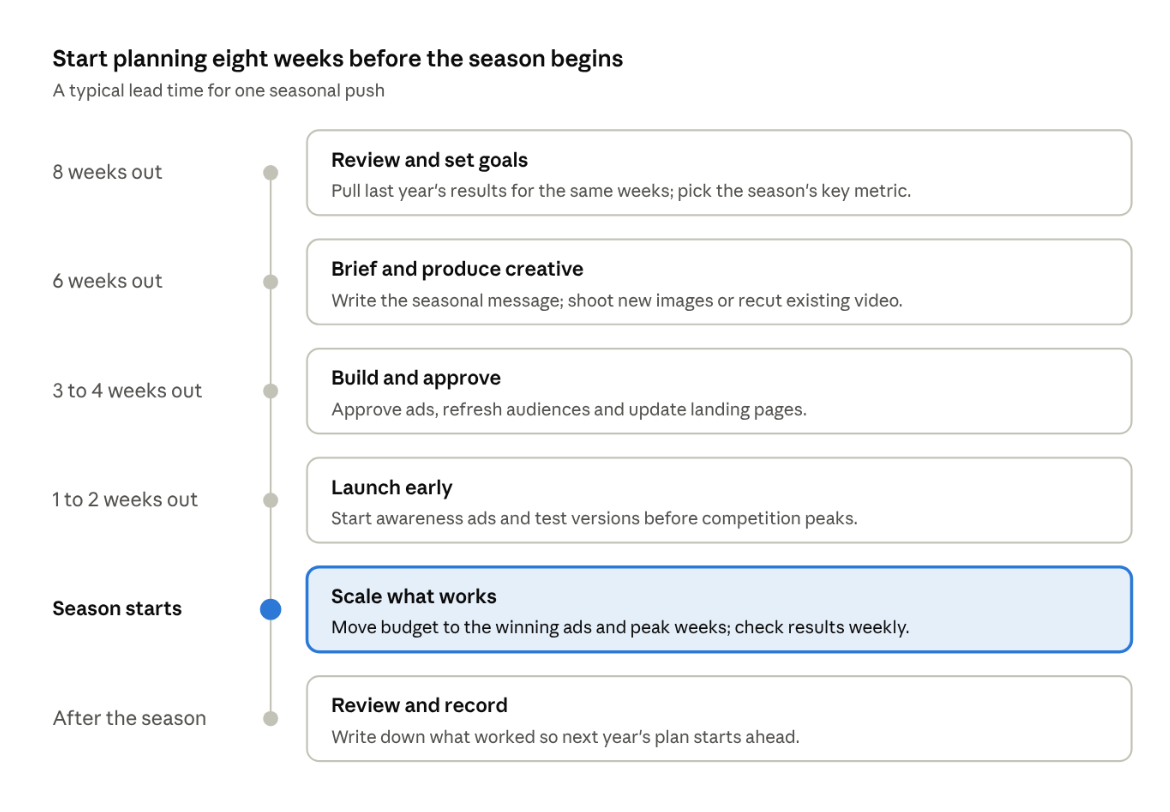
For most seasonal pushes, start about eight weeks out. That leaves time to learn from last year, produce new creative and launch before costs peak.

Seasonal planning timeline · 6 steps


For the busiest stretch of the year, from Black Friday through the holidays, add a few more weeks. Bigger budgets, more creative and higher competition all need a longer runway.

Your seasonal refresh checklist

  1. Before each new season, run through these questions with your team or your agency:
  2. What happened this time last year? Look at last year's results for the same weeks: what sold, what it cost, and when demand peaked.
  3. Which ads are tired? Check frequency and click-through rate. Retire anything that's been running too long with falling engagement.
  4. What's the seasonal message? Write one sentence that ties your offer to what customers care about right now.
  5. Is new creative ready? Images, video cuts and copy should be approved before the season starts, not during it.
  6. Where should the budget go? Shift spend toward your peak weeks and channels, and trim it where you'd be competing for no reason.
  7. Do the landing pages match? Update offers, imagery and dates on your site so the click lands somewhere consistent.
  8. Are audiences up to date? Refresh retargeting lists and exclude recent buyers who don't need to see the same offer again.
  9. How will you measure it? Decide on the key number for the season, such as cost per lead, bookings or online orders, and check it weekly.

Stay a season ahead

The businesses that win each season rarely do it by reacting faster. They win because the plan was ready before the season began. Fresh creative, budget aimed at the right weeks and messages that match what customers are thinking all add up to a lower cost per result and a stronger return on every dollar.


If your ads look the same today as they did in the spring, now is the time to start. Holiday campaigns are already underway, and the best time to plan your first quarter is right now. Reach out to our team, and we'll help you map out a seasonal plan built around your business calendar.

Share

Smiling woman in black top and jeans sitting on a bench indoors, with one leg crossed.
By Performance Digital • November 3, 2026
Author: Addy Combs
Man in foil hat points upward beside bold “10K WEBSITE” and “NO CODING” text on orange background
By Brayden Will • October 27, 2026
As a designer I try and educate myself on recent design trends and things going on in that world as much as possible. Through my education and experience I have spent a lot of time on designing and building websites, never in my experience has it gone well without someone opening a code editor.  Today, new AI tools can write code, lay out pages, and make a “working” website faster than I can pick a font. The world likes to say that AI is coming for people’s jobs in this area specifically targeted at web/UX designers. To me it’s not the tool that I worry about, it’s the people abusing the system that are. Over the last few months, I’ve noticed and defined two types of people that are worth looking out for.

Hands holding smartphones in a circle on a table, with colorful app icons floating above each screen.
By Performance Digital • October 20, 2026
Social media and the internet have been part of everyday life for years, but the way people use these platforms continues to change. As social platforms have added more features, integrations, search capabilities, and shopping tools, they have also changed how businesses reach customers, and how customers move through the marketing funnel. The traditional marketing funnel is usually viewed as a fairly straightforward journey: someone becomes aware of a business, develops interest, considers their options, and eventually converts. Today, that journey is much less linear.
Text reading “How to Handle Negative Comments Without Damaging Your Brand” beside a thumbs-down icon
By Performance Digital • October 13, 2026
Every brand with a comment section will eventually get a bad one. What separates a one-off complaint from a lasting reputation hit isn’t the criticism itself. It’s what your brand does next. A single unhappy comment rarely sinks a brand. A slow, defensive, or tone-deaf reply is what turns it into a story. The good news? Handling criticism well is a skill, not a personality trait. It comes down to a few repeatable habits.

Billboard reading “THE BILLBOARD TEST” on a gray sign against a blue sky.
By Performance Digital • October 6, 2026
Learn why short headlines, minimal copy, and clear visual hierarchy can improve display ad and landing page performance and help drive more clicks.

Robot elephant in a modern office, surrounded by coworkers watching it attentively
September 23, 2026
A practical look at where AI helps marketers and where human judgement still matters.